

Overview
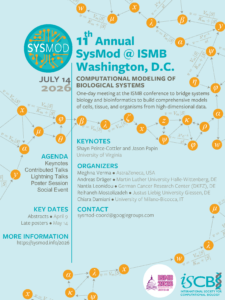
Advances in genomics are creating new opportunities to understand the biology that require both systems modeling and bioinformatics. The eleventh annual SysMod meeting will be a forum for discussion about the combined use of systems biology modeling and bioinformatics to understand biology, and disease. The meeting will take place in July 2026, during the 2026 ISMB/ECCB conference  in Washington, DC, USA. The meeting will feature two keynote talks and contributed presentations.
Topics
Methods
Dynamical modeling Flux balance analysis Logical modeling Network modeling Stochastic simulation …
Systems
Animals Bacteria Humans Plants Yeast …
Applications
Bioengineering Cancer Developmental biology Immunology Precision medicine …
Keynote speakers

Shayn Peirce-Cottler
Department of Biomedical Engineering
University of Virginia

Jason Papin
UVA School of Medicine
University of Virginia
Session Chairs

Prof. Dr. Andreas Dräger
Martin Luther University Halle-Wittenberg, Germany

Prof. Peter D. Karp, Ph.D.
SRI International, USA
Schedule on July 14, 2026
| 11:00-13:00 | Session I: Computational Disease Dynamics and Therapeutic Modeling |
|---|---|
| 11:00 – 11:20 | Welcome and Introduction to SysMod 2026
The community of special interest (COSI) in systems modeling (SysMod) organizes annual one-day gatherings. In 2026 the meeting comprises three sessions that cover a broad variety of topics, beginning with metabolic modeling, followed by the afternoon session on multiscale modeling and concludes with inference of cellular processes. This year’s meeting features two keynote speakers, Shayn Peirce-Cottler and Jason Papin. |
| 11:20-12:10 | Keynote talk: From Single-Cell Decisions to Tissue-Scale Disease: A Multiscale Modeling Framework Shayn Peirce-Cottler University of Virginia, USA Many of the most prevalent and challenging human diseases—including cancer, cardiovascular disease, and fibrotic disease—emerge from dynamic, multiscale interactions among heterogeneous cell populations and their evolving microenvironments. Yet most therapeutic strategies and computational models focus on isolated molecular targets, limiting their ability to predict or influence emergent tissue-level behavior or patient-specific outcomes. Addressing this gap requires mechanistic models that explicitly link intracellular signaling, cell phenotypic decision-making, and tissue-scale remodeling across space and time. In this talk, I will present our laboratory’s work developing multiscale mechanistic computational models that integrate molecular, cellular, and tissue-level processes to study disease onset and progression. Our approach centers on agent-based modeling, enabling explicit representation of individual cells, stochastic behaviors, and cell–cell interactions while capturing emergent, tissue-scale dynamics. These models are specified and parameterized using data-driven, machine learning approaches, allowing us to incorporate high-dimensional experimental data while preserving mechanistic interpretability. Importantly, our modeling efforts are tightly coupled to experiments in an iterative loop. We design experiments to probe single-cell behaviors and microenvironmental cues, use these data to refine model structure and parameters, and then generate testable predictions regarding tissue-scale adaptations. Using this framework, we have studied microvascular network and tissue remodeling in development, regeneration following injury, and fibrotic disease. Together, these studies demonstrate how multiscale mechanistic models can reveal causal links between cellular decision-making and tissue-level disease phenotypes, providing a predictive foundation for rational therapeutic design.
|
| 12:10-12:30 | Disentangling cellular dynamics of co-occurring processes via stochastic graph transport Jie Sheng, Noah Cohen Kalafut and Daifeng Wang
Complex systems exhibit dynamics governed by the interplay of intrinsic, co-occurring processes. For instance, emerging single-cell and spatial transcriptomics data reveal that cellular gene expression changes entangle simultaneous biological processes like maturation, proliferation, and spatial organization. Current trajectory inference methods for dynamic analysis typically impose a global smoothness constraint, ordering cells into an aggregated, uni-scale progression that conflates distinct processes and thus overlook their specific dynamic patterns. To address this, we developed VAPOR, a generative framework to infer and disentangle latent dynamics for co-occurring biological processes from single-cell data. To reconstruct continuous transitions from static observations, we employ a Markov process that leverages graph transport on a local stochastic neighborhood graph to estimate feasible state transitions for each cell in the variational autoencoder latent space. Using such transitions, VAPOR models and infers latent dynamics as ordinary differential equations. More importantly, it decomposes the latent dynamics into a set of process-specific components parameterized by transport operators (TOs) and their corresponding weights. Each TO defines a process-specific dynamic component, and its weight for each cell quantifies the process’s contribution to the cell’s dynamics with associated dynamic genes. After simulation studies and benchmarking, we applied VAPOR to diverse real-world datasets, including cross-species brain development, multiplexed cancer drug responses, and spatial transcriptomics of the mouse hippocampus. VAPOR disentangled a variety of temporal and spatial co-occurring processes, such as neuronal differentiation, cell cycle, and extracellular signal-regulated kinase (ERK) suppression after drug treatment. Furthermore, VAPOR also identified corresponding dynamic genes for those processes, such as RBFOX3, showing an earlier progression in macaque than human neurogenesis. |
| 12:30-12:40 | Mechanistic ODE modeling of MAPK/AKT signaling reveals scheduling-dependent control of persister dynamics in BRAF-mutant melanoma Ethan Wang
Melanoma relapse is frequently associated with drug-tolerant persister cells, rare tumor subpopulations that survive targeted therapy through adaptive signaling rather than stable genetic resistance. Because these cells remain dependent on MAPK and RTK/AKT signaling, combination strategies that disrupt both pathways may improve control of drug-tolerant populations. Here, we present a mechanistic ordinary differential equation (ODE)-based model to investigate treatment scheduling strategies combining a PROTAC degrader targeting mutant BRAF with an RTK inhibitor. The model integrates MAPK and AKT signaling dynamics, downstream transcriptional programs, and tumor population behavior, with drug action represented through two-compartment pharmacokinetics, bolus dosing, and Hill-type pharmacodynamics. Treatment performance was evaluated using a persister index (PI) together with a composite optimization score (COS) that balances persister burden and drug exposure. Screening across a large set of candidate regimens identified scheduling strategies that reduce simulated persister populations relative to baseline conditions. Regimens incorporating early PROTAC exposure followed by sustained RTK inhibition achieved the largest reductions in PI while maintaining lower modeled toxicity penalties. Additional analysis across simulated tumor phenotypes revealed variability in optimal schedules, reflecting differences in underlying signaling dynamics. Overall, this framework demonstrates that, within a mechanistic modeling context, treatment scheduling can substantially influence persister dynamics and comparative performance metrics. These results provide a basis for exploring combination treatment strategies and generating hypotheses for future experimental validation of scheduling-based approaches to targeting melanoma persister cells. |
| 12:40-13:00 | Computational pipeline elucidates how single-cell, lymphocyte motility behaviors drive B-T interactions that mediate the antibody response Nikita Sivakumar, Chanhong Min, Kibaek Choe, Wendy
Lymphocytes rely on cell motility to navigate tissue environments and engage in cell-cell interactions that support the adaptive immune response. Within germinal centers, B-cells and T-cells rely on cell motility to encounter and engage in B-T interactions that enable antibody affinity maturation. Systematically quantifying how B-cell and T-cell motility influences B-T interactions within germinal centers can inform what cellular mechanisms support a healthy antibody response to infection or vaccination. Experimental methods, alone, cannot simultaneously image single-cell motility in vivo and all B-T interactions within high-density tissue environments, like the germinal center. To close this gap, we developed and validated PRISMM (Pipeline for Recapitulating Cell-Cell Interactions using Spatial Motility Modelling). PRISMM first applies unsupervised machine learning to learn single-cell, lymphocyte motility behaviors from intravital, time-lapse imaging data. PRISMM then applies agent-based simulations to infer how these motility behaviors drive B-T interactions. The application of our pipeline identified that germinal center T-cells tend to take on fast and exploratory movements, while B-cells tend to move more slowly. Our simulations show that these distinct motility behaviors allow B-cells to maximize unique interactions with T-cells within confined volumes. This result suggests that baseline lymphocyte motility behaviors optimize B-T interactions during a physiological antibody response. PRISMM leverages the single-cell nature of motility data to identify distinct, in vivo cell motility behaviors. Our pipeline can then predict how these single-cell motility behaviors drive emergent cell-cell interactions. Using PRISMM we can understand how cell motility influences cell-cell interactions in healthy and disease contexts. |
| 13:00- 14.20 | Lunch Break |
| 14.20-16.00 | Session II: Multi-Scale Systems Biology and Network Modeling |
|---|---|
| 14:20-15:10 | Keynote talk: Predicting microbial metabolic function for therapeutic development Jason Papin University of Virginia, USA
With the explosion of data characterizing the genotype-phenotype relationship of microbes under diverse conditions, there remains the challenge to interrogate such data to better understand and predict metabolic functions of microbes. Computer models have become indispensable tools to address these challenges. We will discuss recent methods to construct and test computer models of microbial metabolism and how these models are shaping the way we think about and design therapeutic strategies to treat human disease. |
| 15:10-15:30 | Metabolic signatures of immune checkpoint inhibitor response in gynecologic cancers: Insights from flux balance analysis Gideon Idumah, Lin Li, Lamis Yehia, Haider Mahdi and Ying Ni
Modifiers of immune checkpoint inhibitor (ICI) responses in cancer patients are complex and remain poorly characterized, especially in gynecologic cancers. In this study, we explored fluxomic biomarkers that differentiate responders from non-responders to ICIs in a series of 49 patients with gynecologic cancers, including ovarian, cervical, and endometrial cancers. By applying metabolic enzyme expression as constraints, we utilized an objective-customizable flux balance analysis within a genome-scale metabolic model to predict the metabolic flux differences between responders versus non-responders of ICI treatment. We identified three reactions with consistent differential activity across all ten different optimization objectives: Succinate Dehydrogenase (SUCD1m) in the citric acid cycle, NADH: Guanosine-5-Phosphate Oxidoreductase (r0276) involved in purine catabolism, and Ornithine Transaminase Reversible, Mitochondrial (ORNTArm) in the urea cycle. Additionally, reactions within the folate cycle subsystem, particularly involving MTHFD2, demonstrated significance in distinguishing treatment responses, aligning with previous findings linking MTHFD2 to immune evasion and tumor progression. To further analyze the association between metabolic features and survival outcomes, we implemented machine learning models that integrate multi-omics data. Our model included clinical-pathologic, molecular-genomic features (gene expression, TGF-β score, immune cell abundance from transcriptomic deconvolution), and significant reaction fluxes. Our findings suggest that SUCD1m, MTHFDm and ORNTArm are important metabolic biomarkers that could serve as predictive indicators for ICI response and, if validated in a larger cohort, may guide the development of targeted therapies to enhance treatment efficacy for gynecologic cancer patients. This study highlights the use of genome-scale metabolic modeling to identify clinically relevant biomarkers and improve therapeutic strategies. |
| 15:30-15:50 | SPECIMEN powered by refineGEMs for streamlined automated high-quality genome-scale modelling Carolin Brune, Gwendolyn Olivia Döbel and Andreas Dräger Background: Systems biology aims to provide a systematic, comprehensive understanding of living systems at all scales through context-specific computational models. Metabolism has been identified as a primary aspect for this endeavour because of its well-defined physico-chemical foundations and its involvement in all aspects of life. In many applications, genome-scale metabolic models (GEMs) have demonstrated their usefulness to predict various phenotypic features based on firm principles. Even though GEMs follow relatively simple mathematical structures, their reconstruction and curation are demanding and still involve many manual steps. Results: We introduce SPECIMEN, a collection of workflows designed for automated, standardised strain-specific metabolic modelling and GEM curation. SPECIMEN primarily utilises the toolbox refineGEMs, which provides a database of defined growth media and a plethora of functions for reading, manipulating and curating individual aspects of GEMs, including mass/charge curation and the assignment of SBO terms and EC numbers. RefineGEMs demonstrated its usefulness in reconstructing five C.-striatum models. SPECIMEN combines these functions to provide two principal reconstruction pipelines, both based on previously published methods: the High-Quality Template-Based (HQTB) and the CarveMe-ModelPolisher (CMPB) workflow. CMPB starts from a CarveMe-generated draft model, refines and extends it into a high-quality, strain-specific model, whereas HQTB employs a user-provided template model and genome as its basis for reconstructing a new model. Conclusion: The combination of both tools drastically reduces manual effort while semi-automatically producing directly usable, high-quality GEMs that comply with all current standard operating procedures and best-practice guidelines. Availability: Both Python-based open-source software solutions are freely available at github.com/draeger-lab/SPECIMEN and github.com/draeger-lab/refineGEMs. |
| 15:50-16:00 | Poster Pitch Talks Zachary Moshe: Leveraging Simulated Spatial Omics to Develop and Benchmark Counterfactual Prediction of Tissue Perturbation Effects
It is evident that spatially resolved biomolecular profiles, such as spatial ‘omics data can provide insight into the mechanisms of disease and treatment induced changes. However, due to the heterogeneity of tissues, perturbation effects can be complex and dependent on spatial context. Here we present a strategy for evaluating computational methods for spatial ‘omics perturbation effect prediction. Developing and comprehensively benchmarking perturbation effect prediction models for spatial omics will facilitate the study of how tissue context and perturbation distribution drive response, allowing for further mechanistic understanding and therapeutic optimization. These potential benefits come with substantial additional challenges as tissue context and spatial perturbation distribution increase the complexity of response modifying covariates and applied treatment respectively. To begin to address this problem, we devise and apply a hybrid data simulation strategy based on scDesign3, previously used to benchmark single cell perturbation models, and scCube, used to generate realistically complex spatial patterns, to benchmark the adaptation of single cell perturbation prediction methods to spatial omics. This strategy allows for the generation of simulated spatial ‘omics data with complex response relationships modified by both spot composition and neighborhood effects to assess recovery of these new factors introduced by spatially resolved ‘omics with counterfactual ground truth. To validate the utility of this strategy, we examine the correspondence between simulation performance and performance on spatial ‘omics data of tumors treated with heterogenous radiation therapy and of murine Alzheimer’s model brains. This serves as a foundation for further development of spatial ‘omics perturbation prediction methods.
Microbial species exhibit a remarkable diversity in their metabolic properties, genome composition, and ecological distribution. However, it is currently not well understood how the structure of metabolic networks defines and reflects the lifestyle and phenotypic properties of diverse bacterial species across the tree of life. By analyzing thousands of genome-scale metabolic models of bacteria, we found a percolation-like transition characterized by a sharp increase in metabolic network functional connectivity. This transition – primarily associated with the completion of central carbon metabolism and the TCA cycle – occurs at a threshold of approximately 800 metabolic reactions or about 2000 protein-coding genes. Strikingly, species with metabolic network sizes below the transition are typically obligate symbionts, while species above it, are predominantly free-living generalists. The observed percolation transition is also reflected in multiple other genomic properties, such as a substantial decrease in the fraction of regulatory genes below the transition and increased evolvability for new metabolic phenotypes above the transition. Furthermore, we found that the distribution of bacterial genome sizes from unbiased environmental metagenomic sequencing also reveals two regimes corresponding to the observed transition. Overall, our work identifies two qualitatively different regimes in microbial metabolism and lifestyles, characterized by distinct structural and functional properties of their metabolic networks.
Genome-scale reconstructions of metabolic networks are powerful tools for studying metabolism at a systems level. The process of generating reconstructions involves several steps (e.g., gene annotation, compiling a draft network, gap-filling, etc.), all of which rely heavily on prior genetic and/or biochemical data. This reconstruction data can be obtained from multiple sources, and each source has its own advantages and limitations which affect the reconstruction process; however, the impact of data selection on the quality of reconstructed networks has not been systematically evaluated. To address this gap, we generated different sets of reconstruction data with varying levels of annotation accuracy or taxonomic coverage. We used each set of data to produce metabolic networks for several strains of bacteria. We compared these networks to manually curated ones for the same strains to assess reconstruction quality. Despite having different methods, two reconstruction tools, CarveMe and Reconstructor, perform similarly when they use the same reconstruction data. Additionally, while data with misannotated genes consistently worsened reconstruction quality, the magnitude of this impact varied considerably from one organism to another. Finally, adjusting which species were represented in the reconstruction data significantly affected reconstruction. When the data included species that were closer to the target organism, both precision and recall improved. Conversely, greater taxonomic coverage had little impact on recall and decreased precision. These results emphasize the importance of data selection and demonstrate principles to improve automated reconstruction of metabolic networks.
Melanoma tumors often contain heterogeneous subclones, typically with proliferative or invasive phenotypes. These subclones interact with each other and the immune system to shape tumor progression. Understanding these interactions between subclones and the tumor microenvironment is a fundamental challenge for optimizing melanoma treatment. To analyze such interactions, we developed dedicated in vivo melanoma mouse models and new mathematical models to study such interactions. In the experimental models, admixtures of proliferative and invasive subclones of varying proportions were implanted into immunocompromised and immunocompetent mice. Tumor growth and subclone composition were tracked over time. In parallel, we built a computational model to capture the interactions between subclones and the immune system. By estimating parameter values of our mathematical model using the experimental measurements, we found that, while the proliferative subclone outgrew the invasive subclone, T cell activities selected for the invasive subclone. The initial subclonal proportion in this dynamic system determines the overall tumor sensitivity to immune response. The key subclone-subclone and subclone–immune interactions identified in this study provide insights into how intratumor heterogeneity and immune pressure influence melanoma progression, suggesting strategies for optimizing therapeutic timing and adaptive treatment.
Fine particulate matter (fPM) is a class of air pollutant and carcinogen known to increase risk of pulmonary diseases and lung cancer. Given the complexity and diversity of these environmental exposures, mechanisms and systemic changes that lead to lung dysfunction remain understudied. The bronchial epithelium, one of the first internal tissues to interact with fPM upon exposure, acts as an important physicochemical barrier to protect proximal and distal lung tissues and against secondary effects on other organs. Deleterious cellular phenotypes, such as metabolic reprogramming and oxidative stress have been observed with fPM exposure. We have observed increased protein oxidation in bronchial epithelial cells (BECs) following fPM exposure. Oxidation not only affects protein structure and function, but also has cascading effects on cell signaling, proliferation, and metabolism. While several individual cellular pathways have been implicated after fPM exposures, these isolated effects are insufficient to account for the complexities of fPM-induced stress responses. To address these gaps in the field and perform a systematic characterization of the pathways altered following fPM exposures, we use in silico metabolic network modeling to simulate fPM exposure in BECs. Our computational models suggest dysregulated metabolism related to carbohydrate, nucleotide, and amino acid metabolism after fPM exposure in BECs. By combining in silico modeling techniques with redox proteomics, we broadly explore cellular changes as well as identify impacts of protein oxidation. Altogether, this systems-based approach will characterize changing interactions within multi-omic landscapes from fPM exposure and help uncover causal mechanisms in the development of fPM-induced pulmonary diseases. |
| 16:00- 16.40 | Coffee Break |
| 16.40-18.00 | Session III: Dynamical Modeling of Cellular State Transitions |
|---|---|
| 16:40-17:00 | Decoding Anti-TNF therapy outcomes from pre-treatment single-cell data via network-based perturbation modeling Mathilde Meyenberg, Matthew Leipner, Alan James, Mueller-Breckenridge and Jörg Menche
Despite anti-TNF therapies being a cornerstone of IBD management, non-response rates remain as high as 40%. To address the lack of predictive baseline biomarkers, we developed a computational framework that leverages multi-layer network integration and in silico perturbation modeling to predict drug response from pre-treatment single-cell transcriptomics. Using longitudinal data from UC and CD patients treated with adalimumab, we construct cell-type-specific networks by mapping Wilcoxon-ranked genes to a protein-protein interaction (PPI) network. To ensure disease relevance, networks are filtered using LCC-based z-scores, retaining only those where IBD-associated modules show significant connectivity. These layers are integrated into multiplex networks, where cell-specific disease neighborhoods are defined via a multiplex random walk with restart (RWR). These network neighborhoods define subnetworks that reveal distinct differences in connectivity around IBD genes for CD and UC. To model perturbations, layer-specific subnetworks are merged into union graphs representing disease (inflamed cells) and reference states (non-inflamed cells) from pre-treatment data. We simulate therapy by deleting target nodes and edges, evaluating the impact via a graph hopper kernel. This kernel utilizes semantic gene embeddings and topological features to compare graph similarity. By deriving a normalized effect score from the resulting distance matrices, we successfully recover a differential signal of anti-TNF response from baseline data alone. By investigating the cell-specific connectivity around TNF on the multiplex networks, we gain biological insights into how pre-treatment cellular signaling influences clinical outcomes. |
| 17:00-17:20 | PIMENTO: a Physics and bIology-inforMed Neural network for dynamic inference of gene regulatory networks to model plant response to biotic stresses Xavier Amorós-Gabarrón, Alessandra Goncalves Ribeiro, Krishna Kumar, Pratila Debnath, Regis Duvigneau, Justyna J. Olas, Lorenzo Sala and Silvia Bottini
In a scenario of climate change, plants are exposed to an increasing variety of pathogens, accompanied by additional hostile conditions. Comprehensive understanding of plant immunity is essential to ensure food production and security. Gene regulatory networks (GRNs) provide a powerful representation of these intricate regulatory systems. However, most inference methods measure only static properties and face the trade-off between scalability and mechanistic interpretability. Here, we propose PIMENTO, a novel hybrid model based on physics-informed neural-networks to infer fully interpretable GRNs from time-series omics data. This approach exploits the ability of neural-networks to approximate high-dimensional systems in combination with explicit ODEs and prior biological knowledge. PIMENTO showed robustness on synthetic data compared to random predictors when inaccurate prior is provided, when trained on as few as 4 timepoints and noise. PIMENTO on 21 time-series (3-7 timepoints, 2- 8 replicates) of tomato (Solanum lycopersicum) plants upon infection by diverse economically important pathogens, with prior network composed of 11822 genes, 277 transcription factors (TFs) and 66343 edges, yielded several TFs with pivotal role in plant defense. Among the top 10, Solyc12g009240-ERF16 and Solyc06g070900-TCP17 were functionally validated using the virus-induced gene-silencing system in tomato, demonstrating their key role in the response to Botrytis cinerea infection, as silencing of either TF resulted in increased susceptibility. Overall, PIMENTO showed good performances regarding scalability, interpretability, predictivity and suitability to model time-series with few timepoints, which will fulfil a gap in the literature. PIMENTO can be used beyond plants, since the model is agnostic of the biological system |
| 17:20-17:40 | Mechanistic modeling of rTMS-mediated quiescent cell targeting in glioblastoma Chitransh Dave, Vrutti Mehta, Kenza Benzeroual and Nicolas Gallo
Glioblastoma (GBM) remains highly resistant to therapy in part because hypoxia, impaired perfusion, and treatment-associated cell-state transitions create a microenvironment that favors quiescent, therapy-resistant tumor populations. These latent physiological states are not well captured by models that evaluate treatments in isolation, despite their major influence on therapeutic response. We developed a mechanistic ODE-based computational framework to test whether repetitive transcranial magnetic stimulation (rTMS) can shift this balance by modulating intratumoral perfusion and oxygenation, thereby reducing quiescent-cell burden. The model couples proliferating, quiescent, and necrotic tumor compartments with hypoxia–perfusion dynamics and rTMS as an upstream physiological perturbation. In this framework, rTMS is not treated as a direct cytotoxic agent, but as a driver of downstream changes in perfusion, oxygenation, delivery, and cell-state transitions that alter treatment sensitivity. Simulations across a heterogeneous Monte Carlo virtual patient cohort, combined with scenario exploration and sensitivity analysis, reveal parameter regimes in which modest hemodynamic changes reshape tumor burden and alter combination response. Together, these results establish an in silico test platform for studying neuromodulation-enabled therapeutic synergy in GBM. |
| 17:40-17:55 | Closing Remarks
This concluding talk aims to briefly discuss the diversity of topics presented at the “Computational Modeling of Biological Systems” (SysMod) COSI track. This diversity illustrates the importance of the field and the broad range of applications in systems biology and disease. Then, forthcoming meetings of interest will be announced, and the three poster awards will be delivered as a closing event. |
Poster presentation:
In Silico Validation of a Dual-Sensing CRISPRa Genetic Circuit for Personalized Diabetic Wound Therapy
Priya Emani
Systems Pharmacology Analysis of Off-the-Shelf Peptide Vaccine Combined with PD-1/CTLA-4 Blockade in Fibrolamellar Carcinoma
Osman N. Yogurtcu, Joel Eliason, Aleksander S. Popel, and Hong Yang
The full combination yielded modest tumor shrinkage (-16.4% best diameter change), outperforming simulated ICI-only conditions, directionally consistent with modest historical ICI activity. Removing the vaccine/adjuvant reduced peak lymph-node pMHC-II (38.8%) and activated CD4+ cells (45.0%). Removing nivolumab increased the week-10 exhausted-to-active intratumoral CD8+ ratio 3.18-fold, worsening tumor response by 16.4 percentage points and accelerating progressive disease. Omitting ipilimumab reduced peak activated lymph-node CD4+ (43.3%) and tumor CD8+ effectors (22.5%). A 4-week vaccine lead-in before ICI worsened tumor response by 6.5 percentage points and attenuated early lymph-node CD8+ priming, qualitatively matching clinical trial observations.
This model supports a mechanistic division of labor: FLC-Vac drives class-II/CD4+ priming, nivolumab restrains local CD8+ exhaustion, and ipilimumab augments CD4+/Treg control to enhance intratumoral CD8+ accumulation. Concurrent ICI initiation proved superior to a vaccine lead-in. These preliminary estimates warrant further refinement via virtual-patient analyses.
DeepTaxa: A Hybrid CNN-Transformer Architecture for Hierarchical Taxonomic Classification of 16S rRNA Sequences
Ahmed Moustafa, Rana Salah Khalel, Khlood Abdelaal, Lobna Ghonaim, and Olaitan I. Awe
Trained on Greengenes2 2024.09 (277,336 training / 69,335 test sequences), the hybrid model achieves 92.9% species accuracy with tight cross-seed reproducibility (std < 0.04 pp). Against DADA2’s naive Bayesian classifier on the same test set, DeepTaxa gains +2.1 percentage points at the species level while running roughly 50 times faster on a single GPU. To rigorously evaluate each component, we conducted Optuna-based hyperparameter optimization (20 trials per architecture) so that every variant receives a fair comparison at its best configuration. The optimized hybrid (92.97%) outperforms the optimized CNN-only (92.29%) and BERT-only (86.41%), confirming that both branches contribute meaningfully. The BERT-only model performs catastrophically (4.7%) with the hybrid’s default hyperparameters but recovers to 86.4% with proper tuning, highlighting how sensitive transformers are to learning rate on genomic data. Similarity-stratified testing shows predictable degradation with decreasing train-test identity: 95.3% for high-similarity sequences (>97%), 68.1% for medium (90–97%), and 47.8% for low (<90%). Zero-shot evaluation on in-silico V3-V4 and V4 amplicon extractions shows that shorter fragments lose information as expected (59.5% and 37.4%, respectively). Across all scenarios, the model maintains well calibrated confidence estimates (ECE < 0.03), making predictions suitable for downstream filtering in metagenomic pipelines.
Kinetic modelling of multimeric protein complexes in yeast
Xavier Castellanos-Girouard, Stephen Michnick, and Adrian Serohijos
Protein-protein interaction (PPI) networks are among the most comprehensively mapped biological networks, benefiting from large-scale experimental screens across model organisms. These datasets have subsequently driven the construction of theoretical kinetic and thermodynamic models of PPI networks. Advances in quantitative mass spectrometry have enabled the measurement of interaction stoichiometry (a ratio analogous to fraction of protein bound in a complex). However, no comprehensive kinetic models to date have incorporated this variable.
We previously used measurements of interaction stoichiometry to generate the first proteome-wide estimation of dissociation constants (Kd). Building on this foundation, we now integrate interaction stoichiometry, total protein abundances, and known subunit stoichiometries to estimate intracellular numbers of multimeric protein complexes, free (unbound) protein abundance, and effective equilibrium constants (Kds) for multimeric complexes in the budding yeast Saccharomyces cerevisiae.
We find reasonable concordance between our estimates of complex abundances and those from low-throughput experiments in the literature. Further, building on previous models of reversible heterodimeric PPI networks, we construct a kinetic model of the yeast protein interactome to evaluate how perturbations in specific protein abundances propagate through neighbouring complexes. Finally, we systematically investigate whether gene pairs demonstrating high network sensitivity to abundance changes also exhibit genetic interactions.
Robust and Interpretable Modeling of Dynamic Metabolic States from Longitudinal Multi-Omics under Dietary Perturbation and Aging
Kira Liu, Dudley Lamming, and John Denu
The framework embeds transcriptomics, compositional histone post-translational modification (PTM) proteomics, and metabolomics into a shared latent space using a latent factor model. We infer state structure with ensemble density peak clustering (eDPC), combined with kernel density estimation, automatic cluster-number selection, and bootstrap resampling to improve robustness. In simulated benchmarks, eDPC achieved 14.6% higher mean ARI and 48.1% lower center estimation error than DPC. For interpretability, we use a time-varying mixed-effects model to characterize directional and temporal molecular patterns and map them back to latent space, enabling each inferred state to be defined by its molecular dynamics and linked to metabolic phenotypes.
We then applied this framework to longitudinal liver multi-omics data from diet-perturbed and aging mouse cohorts, with Western diet control and short-term BCAA restriction followed by Western diet repletion at multiple time points. This design enabled integrated analysis of perturbation response, recovery trajectories, and age-dependent metabolic remodeling.
We uncovered a distinct metabolic state associated with epigenetic memory, persistently elevated energy expenditure, and reduced hepatic lipid accumulation. Our framework enables interpretable multi-omics state discovery and mechanistic insight. Acknowledgment: Data from unpublished work by Calubag et al. (Denu and Lamming labs).
GSFM: A Gene Set Foundation Model Pre-trained on a Massive Collection of Diverse Gene Sets Applied to Gene Set Enrichment Analysis
Daniel Clarke and Avi Ma’Ayan
Identifying translatable axes of drug resistance in NSCLC via integration of patient and PDX single-cell transcriptomics
Paulina Eberts
Discerning which PDX-derived phenotypes reflect human biology versus model-specific artifacts remains a fundamental challenge limiting translational utility. Here we employed our TransComp-R (Translatable Components Regression) framework to identify gene covariance structures conserved between human and PDX tumor cells. We integrated scRNA-seq data from TKI-treated patients at three timepoints (treatment-naive, minimal residual disease (MRD), progressive disease) with snRNA-seq data from seven different PDX models collected at equivalent stages.
Differentially expressed genes differentiating human treatment populations were used to construct PDX-derived principal components at the pseudobulk level. Human samples were projected into the PDX PC spaces to identify components along which treatment groups separated in both systems with consistent directionality (validated by logistic regression with 5-fold cross-validation).
Principal components meeting these criteria, reflecting shared gene covariance structures, were designated translatable axes. Individual PDX cells were projected along the translatable axes and pseudo-ordered for single-cell trajectory analysis. MRD-enriched transcriptional signatures pre-existed in untreated tumors, suggesting intrinsic fitness enriched under treatment conditions and implicating genes such as S100A9 as key contributors to the transition. This framework bridges PDX and patient biology to expose the earliest, most therapeutically vulnerable stages of drug resistance.
A Novel Computational Framework for Fractal Analysis of Spatial Transcriptomic Data
Elijah Yu and Xinmin Li
Given the discrete nature of Visium spots, individual spots were assigned deconvoluted topics using STdeconvolve, and subsequently categorized as “tumor” or “host” based on top genes and common tumor-associated markers. Then, Python scripts for the box-counting algorithm were used to calculate measures of monofractal tumor boundary complexity through the fractal dimension (Df), while the Chhabra-Jensen algorithm was used to calculate measures of multifractal complexity with the singularity exponent range (Δα) and singularity spectrum (f(α)).
Df and Δα values were interpreted based on transcriptomic and histological profiles of the tissue sections, and cross-referenced with original findings. Our results demonstrated that higher values of Df and Δα illustrate extensive intermingling and complex interactions between host and tumor tissue, while lower values represent homogeneous tumor regions or a defined host-tumor boundary. Compared to spatial metrics like Moran’s I, which measures spatial autocorrelation, Df and Δα values can quantify boundary complexity and diversity of probability distributions, respectively. The proposed framework offers a novel perspective on the biophysical reality of tumor microenvironments and serves as a proof-of-concept for calculation of fractal metrics across a diversity of spatial transcriptomic platforms.
Structural Determinants of Neuromuscular Transmission Through 3D Reaction-Diffusion Modeling
Dweny Geeth
A novel 3D reaction diffusion model of the neuromuscular junction was developed in MATLAB incorporating curved synaptic fold morphology, clustered receptor distributions, and multistate receptor kinetics. On a 7×9×9 voxel grid with Gaussian diffusion, 12 conditions were simulated across four receptor geometries and three firing patterns (regular 50 Hz, regular 100 Hz, burst 100 Hz), tracking ACh concentration, occupancy, and desensitization.
Burst firing at 100 Hz was the only condition approaching EC50 (~100 µM), sustaining concentrations above threshold for 457 µs, while regular stimulation peaked between 58 and 60 µM regardless of frequency. Receptor clustering was the primary structural driver: clustering alone reduced desensitization from 32% to 14% at 50 Hz, preserving an activatable receptor pool, whereas folds produced negligible changes.
Burst firing induced 70% desensitization versus 23 to 32% under regular firing, reflecting a frequency dependent tradeoff between accumulation and receptor availability. Fidelity index was maximal at 50 Hz (1.00), declined at 100 Hz (0.65), and recovered under burst firing (0.78) via temporal summation.
These results identify receptor clustering as the primary structural driver of ACh signaling, with burst firing uniquely enabling functionally relevant accumulation, informing transmission failure in neuromuscular disease.
A Generative Model for the Synthesizing of Single-Cell Proteomic Datasets for Dynamic Modeling of Cell Signaling Pathways.
Carolina Ribeiro, Cristiano Campos, and Marcelo Reis
Results: We introduce a reusable pipeline for generating synthetic single-cell proteomic (scProteomic) datasets from ODE-based biochemical models. The pipeline provides modular components for simulating signaling dynamics through numerical integration, enabling controlled variability across cell lines and treatments through randomized initial conditions and parameters. Using an IL-6 signal transduction model in hepatocytes, we generated a dataset to evaluate several random forest configurations. The first model predicts ERK abundance from other molecular markers independently of time. The second model employs a set of time-resolved models trained on resampled data of t0 and generating predictions for the other marks for each time point. A refined version integrates predictions from these temporal models into the first model, and a third jointly trains ERK and other markers. Comparison with the available ground-truth trajectories demonstrates the framework’s ability to simulate and benchmark time-series modeling approaches for scProteomic data.
Availability and Implementation The pipeline is freely available at https://github.com/cristiano-campos/scProteomics-GenerativeModel
Contact: c184298@dac.unicamp.br, msreis@unicamp.br
Image-Based Machine Learning For Alzheimer’s Detection
Varun Menon
The model was trained over multiple iterations, allowing it to learn patterns and structural differences within the brain scans associated with each stage of the disease. When shown novel images during testing, the model performed with a high level of accuracy. While this indicates that the model can distinguish between the image groups, it may also be due to overfitting of the data used during training or limitations in dataset size and diversity.
All in all, this project demonstrates the usefulness of deep learning algorithms in identifying patterns within neuroimaging data in order to assist in diagnosing Alzheimer’s disease. However, further study would be beneficial to validate these findings and enhance the reliability and real-world applicability of this algorithm.
TEMPEST: A Probabilistic Framework for Longitudinal Analysis of Sparse, Asynchronous Spatial Data in Tumor-Stromal Assembloids
Eashan Monga, Dina Hany, Jake Chang, Gina Bouchard, and Sylvia Plevritis
Temporal multi-omics modeling resolves sex-specific regulatory mechanisms governing cardiac metabolic adaptation to endurance exercise
Pauline Brochet, Joyce Njoroge, Samuel Montalvo, Malene E. Lindholm, Sasha Gladkikh, Gregory R. Smith, Gina Many, David Jimenez-Morales, Hasmik Keshishian, Nicole R. Gay, Bingqing Zhao, Chia-Jui Hung, Christopher A. Jin, Clarisa Chavez, Daniel Nachun, Elena Zaslavsky, German Nudelman, Hanna Pincas, Jose Juan Almagro Armenteros, Kevin S Smith, Krista M. Hennig, Mary Anne S. Amper, Matthew Wolf, Mital
Vasoya, Nasim Bararpour, Navid Zebarjadi, Nikolai G. Vetr, Roxanne Chiu, Si Wu, Venugopalan D. Nair, Yongchao Ge, Blake B. Rasmussen, Martin J. Walsh, Michael P Snyder, Stephen B Montgomery, Stuart C. Sealfon, William E Kraus, Zhen Yan, Euan Ashley, Matthew T. Wheeler, and Daniel H. Katz
Conversely, Factor 1 identified an early sex-divergent epigenetic signal. Females exhibit chromatin closure at 1w while males show opening at 4w (P≤0.05) at the promoters of critical glucose-glycogen regulators (Pdk4, Ppp1r3d, Ppara). Epigenetic motif analysis identified the metabolic transcription factor KLF15 as the top candidate driver of this divergence. Furthermore, Factor 6-associated proteins were enriched in fatty-acid (FA) metabolism (FDR≤0.05), with a maximal expression at 2w in males, but 4w peak in females. Kinase enrichment confirmed these divergent strategies through GYS1 regulation, where male-specific dephosphorylation at 2w (Factor 7) promotes its glycogen storage function. These results identify a temporal divergence in metabolic substrate preference, where early female adaptation is characterized by oxygen-efficient glucose utilization while males favor fastest FA adaptation. Ultimately, this analysis establishes a cross-omic mechanistic chain linking early epigenetic regulation to downstream signaling and proteomic dynamics.
Temporal competence windows govern four discrete phases of neural progenitor fate commitment in a multi-layer ODE framework of CNS development
Batuhan Safa Kar
How positional signals are translated into discrete neuronal identities across developmental time remains incompletely understood. Transcription factor (TF) competence windows—periods during which progenitors respond to inductive signals—constrain fate decisions, but their system-level dynamics remain uncharacterized.
METHODS
We developed a six-layer ODE framework modeling CNS progenitor fate commitment along anterior-posterior and dorsal-ventral axes, integrating: (1) a bistable GSE/SVE switch via Lhx3-Phox2b mutual inhibition (Hill n=4), (2) rhombomer boundary sharpening via Hoxb1-Hoxb2 cross-repression (Hill n=6), (3) Notch-Delta lateral inhibition, (4) Eph-Ephrin contact barrier, (5) CN VII axon guidance, and (6) temporal TF competence gating across 18 transcription factors. Validity was assessed against 11 quantitative biological criteria, including SHH dose-response benchmarking against Dessaud et al. (2008).
RESULTS
Systematic variation of ODE integration time (t_norm=0.03-1.0) revealed four discrete commitment phases. Phase I (t<0.125): complete progenitor indeterminacy. Phase II (t=0.16-0.38): rapid commitment via sequential TF window opening—somatic motor neurons commit before branchiomotor neurons, recapitulating known in vivo temporal ordering. Phase III (t=0.38-0.875): full commitment, zero residual progenitor fraction. Phase IV (t=1.0): partial reversion caused by Chx10 window closure, isolating ARAS progenitors as a structurally irreducible population. GSE-axis parameters showed R²=0.995 concordance with Dessaud dose-response data (EC50 deviation: 2.6%).
CONCLUSIONS
Temporal TF competence gating—not morphogen signal strength or bistable switch kinetics—is the dominant determinant of commitment timing. The four-phase structure and Hill coefficient independence of commitment rates are emergent properties unreachable by individual subsystem analysis
Identifying clinically relevant cell state interactions in the tumor microenvironment of IDH-mut glioma.
Arashdeep Singh
Here, we present CSI-TME, a computational framework that generalizes the concept of gene-level interactions, such as synthetic lethality, to the level of cell states, enabling the inference of prognostic CSIs directly from large-scale bulk transcriptomic cohorts. Applying CSI-TME to IDH-mutant gliomas, we uncover a highly reproducible cell-state interaction network (CSIN) that is predominantly pro-tumorigenic and exhibits distinct activation patterns between IDH-mutant astrocytoma and oligodendroglioma. Malignant cell states within this network recapitulate multiple neuronal lineage programs, including astrocyte-like and oligodendrocyte progenitor–like states, and reveal key interactions between glioma stem-like cells and T cells.
The CSIN stratifies patient response to immune checkpoint blockade, underscoring its clinical relevance. Approximately 20% of identified CSIs are supported by direct ligand–receptor interactions and show spatial co-localization in spatial transcriptomic data. Notably, we identify a robust pro-tumorigenic interaction between tip-like endothelial cells and hypoxic malignant cells, mediated by multiple ligand–receptor pairs. In contrast, anti-tumor CSIs associated with oncogenic alterations are preferentially active in early disease stages, suggesting a transient tissue homeostatic response.
Collectively, CSI-TME provides a scalable and clinically grounded framework to uncover prognostic cell-state interactions and nominate therapeutic ligand–receptor targets, offering new insights into how coordinated cell-state dynamics shape the TME in IDH-mutant glioma.
Percolation and lifestyle transition in microbial metabolism
Rydberg Supo and Dennis Vitkup
Tissue- and system-level discovery of gero-protective perturbation candidates using transcriptomic signature enrichment
Philipp Trollmann, Rocio Rodriguez Quiroz, Paul Okoro ,and Preshita Dave
SXXX
XXX
Data selection significantly impacts automated reconstruction of genome-scale metabolic networks
Blaine Bates and Jason Papin
Precision Mental Health Analytics: Scalable Brain-Based Models for Population Insights
Anushree Bhople
Spatiotemporal modeling of developmental architecture guides engineering scalable hPSC-derived esophageal mucosa.
Sadhana Gaddam, Ying Yang, Ian Glass, and Anthony Oro
Expressed Gene Landscape (EGL) Analysis: Systems-level Evaluation of Lung Cell Phenotypes and Druggable Targets
Bingfang Xu, Ajith Pankajam, Kumar Arvind, Anne Deslattes-Mays, Matthew Diller, Raymond LeClair, Beverly Peng, Noam Rotenberg, William Spear, Zhizheng Wang, Yun Zhang, and Richard Scheuermann
EGL adopts gene-specific probabilistic base models to estimate the likelihood of gene expression in each cell type. After fine-tuning the base models and applying a data-driven probability threshold, EGL identifies all genes expressed in each cell type. To enable systems-level analysis, EGL generates a binary gene-by-cell-type matrix, with hierarchically organized cell types as columns and genes as rows. By defining input genes using Gene Ontology categories, EGL compares diverse biological functions across cell types. EGL is also integrated with an agentic AI workflow that uses large language models (LLMs) to guide input selection and aid in result interpretation.
Applying EGL to lung single-cell datasets, we constructed gene expression landscapes for key biological processes across lung cell types, defined gene expression landscapes in healthy and diseased lungs, and generated druggable gene expression landscapes. Within each landscape, EGL revealed three patterns of expression: ubiquitously expressed genes, cell-type-selective genes, and genes enriched in specific cell-type classes.
Together, EGL provides a comprehensive view of the functional characteristics of each cell type and serves as a tool for systems-level evaluation of cell phenotypes and therapeutic targets.
Mutation‑Induced Repulsive Hotspots Reshape Nanobody Binding to the Omicron SARS‑CoV‑2 RBD
Mert Golcuk, Fareeda E. Abu-Juam, Derman Basturk, Ayten Dilara Gursel, Clara Xazal Buran, Reyhan Metin Akkaya, Ahmet Yildiz and Mert Gur
Balanced Polymorphism Arising from Temporal Offsets in Temporally Varying Selection
Xavier Larason and Davorka Gulisija
Modeling Cellular State Transitions: An RNA Velocity–Guided Neural Stochastic Framework for Forward Simulation
Bob Zhao
Modeling Macrophage Polarization in Wounds: A Heterogeneity Perspective
Prateek Gupta and Doraiswami Ramkrishna
Modeling and Control of Tumor–Immune Dynamics in a Nonlinear Systems Framework
Seyedehzahra Paylakhi and Robbee Wedow
BMBC-Sim: An open source simulation package for coupled biomechanical and biochemical events
Michael Innerberger, Norma Perez Rosas, Ahmed El Hady, Stephan Preibisch and Kayvon Pedram.
Simulation-Guided Deep Learning for Target-Layer Oxygenation Inference from NIRS Signals
Jinho Park, Dohum Kim, Thien Nguyen and Amir Gandjbakhche
TwinCell: Large Causal Cell Model for Reliable and Interpretable Therapeutic Target Prioritisation
Jean-Baptiste Morlot, Yann Abraham, Elie Hatem and Thomaz Luscher Dias
Drug development is a lengthy process requiring crucial decisions, starting with selecting the right target for a specific indication. Choosing the wrong target can cause significant delays or even failure. Therefore, target identification is a critical area in drug discovery, driving continuous computational biology advancements. However, challenges like cellular heterogeneity and disease context persist. Recent advances in single-cell and spatial molecular biology have generated massive datasets capturing compound effects, often used to train models for perturbation prediction. However, these models frequently fail to generalize or struggle to outperform simpler linear methods. We introduce TwinCell, a new approach that we define as Large Causal Cell Models. TwinCell leverages foundational single-cell models to learn the underlying biology from in vitro perturbational data. It can then predict which driver genes are most likely to be connected with disease-specific differentially regulated genes. To ensure a fair and accurate assessment, we also developed TwinBench, a new benchmark framework that specifically addresses the common “popularity bias” challenge found in recommendation algorithms. We applied TwinCell to both in vitro and in vivo datasets. Our results demonstrate superior performance compared to established methods and show strong generalization to new targets and cellular states not included in the model training. TwinCell and TwinBench represent a major advancement toward creating reliable, interpretable “virtual cells” for target identification, effectively bridging the data from high-throughput in vitro experiments with clinical insights.
Multi-omics integrative clustering revealed three independent molecular subtypes of poor prognosis and drug resistance in acute myeloid leukemia
Flora Mikaeloff, Nona Struyf, Mattias Vesterlund, Huthayfa Mujahed, Trung Nghia Vu, Georgios Mermelekas, Albin Österroos, Anna Bohlin, Sofia Bengtzén, Yudi Pawitan, Rozbeh Jafari, Lukas Orre, Brinton Seashore-Ludlow, Janne Lehtiö, Päivi Östling, Sören Lehmann, Olli Kallioniemi and Tom Erkers
Methods: AML patients (n =110) with complete RNA-seq, MS-proteomics, DNA methylation and mutational screening profiles were clustered using robust consensus clustering. Clusters were characterized by comparing clinical parameters, drug sensitivity from functional ex vivo drug testing data and finding cluster-specific pathways. Clusters were validated in external datasets.
Results: Four cancer subtypes (C1-C4) were identified based on muti-omics clustering. C4 showed the best prognosis, younger age and a favorable ELN compared to the other clusters. C1 and C2 had a bad prognosis which was partially explained by their mutation pattern : high-frequency mutation of NPM1-FLT3 in C1 and NPM1-FLT3-DNMT3A in C2. C1 was sensitive to venetoclax but resistant to FLT3 inhibitors due to the large proportion of immature cells and up-regulation of stemness markers and pathways. C2 had the opposite drug profile and showed a much larger proportion of differentiated and immune cells. C3 had the worst prognosis and had a large proportion of adverse ELN2017. C2 and C3 showed independent up-regulation of calcium pathways. Clusters were validated in external datasets. Interestingly, relapse samples showed an enrichment of C3. Drug combinations and predicted drugs were computed to suggest cluster-specific potential treatments.
Discussion/conclusion: We have identified omics subtypes that can be applied in other cohorts, suggest potential treatments and improve multi-omics precision medicine in the future.
GeneSNAKE: a Python package for simulation of gene regulatory networks and perturbation-induced expression data
Erik Sonnhammer
To address these limitations we present GeneSNAKE, a Python package designed to allow users to generate biologically realistic GRNs and expression data for benchmarking purposes. GeneSNAKE improves on previous work by providing a unique combination of modules, allowing users to control a wide range of GRN and data properties. It provides full control of the noise level, several noise models, full control of the perturbation design, and a wide range of pre-defined perturbation schemes.
For benchmarking, GeneSNAKE offers a number of functions both for comparing network similarity, and properties in data and GRNs. These functions can further be used to study properties of biological data to produce simulated data with more realistic properties. GeneSNAKE is an open-source, comprehensive simulation and benchmarking package with powerful capabilities that are not combined in any other single package, and thanks to the Python implementation it can be extended and modified by users.
Exploring Resource Constraints for Modeling Pairwise Microbial Metabolic Interactions in the Hydra-associated microbes
Natchapon Srinak, Peter Deines, Christoph Kaleta and Jan Taubenheim
A Mechanistic Modeling Framework Integrating Bayesian Optimization to Reveal Critical Mechanogenic Regulations in the Drosophila Wing Disc
Emerald Win
Integration of aged brain multi-omics reveals cross-system mechanisms underlying Alzheimer’s disease heterogeneity
Ricardo Vialle, Lucas Scheidemantel, Katia de Paiva Lopes, Chris Gaiteri, Vilas Menon, Philip De Jager, Julie Schneider, Aron Buchman, Yanling Wang, Shinya Tasaki, Roberto Raittz and David Bennett
Towards a Catalogue of Protein Functional States for Dynamic Regulatory Network Modeling
Szabolcs Cselgő Kovács, Erzsébet Fichó, István Zoltán Reguly and Attila Csikász-Nagy
Supported by the URSP-CDP-24 University Research Scholarship Program – Cooperative Doctoral Programme of the Ministry for Culture and Innovation from the source of National Research, Development and Innovation Fund.
A Scalable Framework for Comparing Centromere Sequence Similarity Using Alignment and k-mer-Based Methods
Christina Mulch
Our approach integrates alignment-based and k-mer-based strategies to capture both large-scale homology and fine-scale sequence variation. Centromere-proximal regions are defined using terminal genomic windows from chromosome assemblies, and all-vs-all alignments are performed using minimap2 with repeat-aware parameters. In parallel, we compute k-mer profiles using Jellyfish and estimate sequence similarity using Mash. We further identify chromosome- and strain-specific sequence signatures by quantifying unique k-mers within centromeric regions and comparing their distribution across samples.
Preliminary results in mouse (Mus musculus) demonstrate substantial shared sequence content among centromere-proximal regions, alongside distinct sets of unique k-mers that differentiate chromosomes and strains. These complementary signals enable the identification of conserved repeat structure as well as strain-specific divergence within centromeres.
This framework provides a scalable and extensible tool for comparative analysis of repetitive genomic regions across samples. Ongoing development focuses on improving computational efficiency, refining similarity metrics, and extending the approach to additional genomes and sequencing platforms. This work lays the foundation for systematic investigation of centromere variation, genome structure, and evolutionary dynamics in complex repetitive sequence contexts.
In silico comparison of three genome-scale models (GEMs) of Bacillus subtilis using Flux Balance Analysis (FBA)
Gabriel Granados
Modeling Alzheimer’s Disease Through Navigation Circuit Degeneration and Brain Rhythms
Pratham Balaji
Integrating single-nucleus RNA-seq with genome-scale metabolic models to predict dementia biomarkers
Seo Young Kim, Junhyeok Jeon and Hyun Uk Kim
From Multi-modal Data to Cross-scale Virtual Kidney Modeling
Lan Jiang and Qifei Wang
Using mutual information-based network-inference algorithms to understand retinal regeneration in zebrafish
Gemma van der Hurk
Transcriptomic Profiling of Fanconi Anemia Subtypes Reveals Splicing and Expression Dysregulation
Hua Tan, Shivatheja Soma, Valer Gotea, Frank Donovan, Kinjal Bhadresha, Oliva Alston, Jeremy Amen, Arleen Auerbach, Agata Smogorzewska, Laura Elnitski and Settara Chandrasekharappa
Key Dates
April 9, 2026
Abstract submission deadline
May 5, 2026
Abstract acceptance notification
May 7, 2026
Late poster submissions deadline
May 14, 2026
Late poster acceptance notifications
Sunday-Thursday July 12-16, 2025
ISMB/ECCB conference
July 14, 2026
SysMod meeting
Registration and fees
Please register for the SysMod meeting through the ISMB conference registration .
Accomodation
ISMB 2026 hotel bookings will be handled directly through the Washington Hilton using special booking links. To help prevent fraudulent reservations, your personalized hotel link will be included only in your registration confirmation and your Checklist emails. A limited student room block is available at a discounted rate on a first-come, first-served basis. Once the student block is full, student attendees will need to use the standard booking link provided by the hotel.
Please register for the conference before booking your accommodations. .Please see the ISMB website for more information.
- Standard accommodation rate $279 per night plus taxes
- Student-only accommodation rate $175 per night plus taxes
- Deadline for Discounted Rate: Friday, June 19, 2026
More information
For more information, please contact the SysMod coordinators 🔗.